
Breaking-news post from The Orbital Times, October 27, 2026.[1]
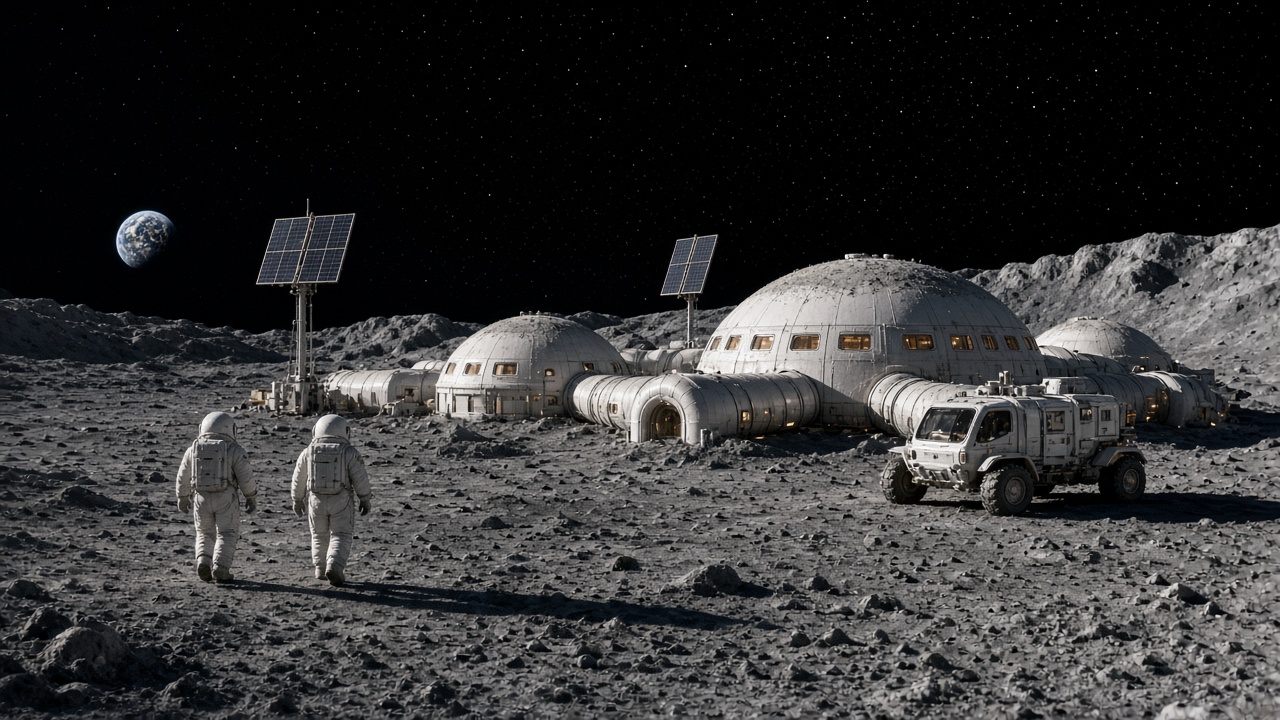
| Type | Permanent human settlement |
|---|---|
| Location | Rim of Shackleton Crater, lunar south pole, Moon |
| Operator | International Lunar Settlement Authority (ILSA) |
| Construction began | 2023 |
| Opened | October 27, 2026, 06:00 ET |
| Population | 48 (2026) |
| Nations | 14 |
| Structures | 11 pressurized domes |
| Floor area | c. 4,200 m² |
| Station chief | Cmdr. Rafael Ortega |
| Travel from Earth | c. 3 days |
Shackleton Station is the first permanent human settlement on the Moon, located on the rim of Shackleton Crater near the lunar south pole. Operated by the International Lunar Settlement Authority (ILSA), a 14-nation body, it was declared open on October 27, 2026, when the last of its 48 founding residents entered the main airlock at 06:00 Eastern Time.[1][2] Unlike earlier lunar outposts with rotating crews, it is designed for year-round residence.[3]
ILSA was formed in 2019 to oversee a permanent lunar settlement.[2] Construction began in 2023, when robotic landers started 3D-printing radiation shielding from lunar regolith.[1] The station was formally opened under Director General Dr. Helena Voss, who described the day as the moment humanity "stopped visiting the Moon and started living on it."[2]
The station consists of eleven pressurized domes linked by tunnels, with roughly 4,200 square meters of space, shielded by nearly two meters of printed regolith.[1] Water is obtained from ice mined in the crater's permanently shadowed floor and is split into drinking water, oxygen and hydrogen fuel. Power is supplied by solar towers on the crater rim, backed by a compact fission reactor buried about one kilometer away.[2] Communications to Earth have a delay of about 1.3 seconds each way.[1]
Residents work 10-day shifts in mining, hydroponic farming, maintenance and science, followed by four days off.[1] Facilities include a centrifuge gym to counter bone loss in one-sixth gravity, a greenhouse producing lettuce, tomatoes and strawberries, and an Earth-facing observation lounge known informally as "the Front Porch."[3] The chief medical officer is Dr. Amara Lindqvist.[1]
The opening was broadly celebrated, with watch parties held from Houston to Bengaluru, and online searches for "how to move to the Moon" rose more than 4,000 percent within an hour.[1] Some scientists criticized the undisclosed cost of the project and questioned whether the crater's ice could sustain a larger population; ILSA said a full environmental report would follow in November 2026.[3]