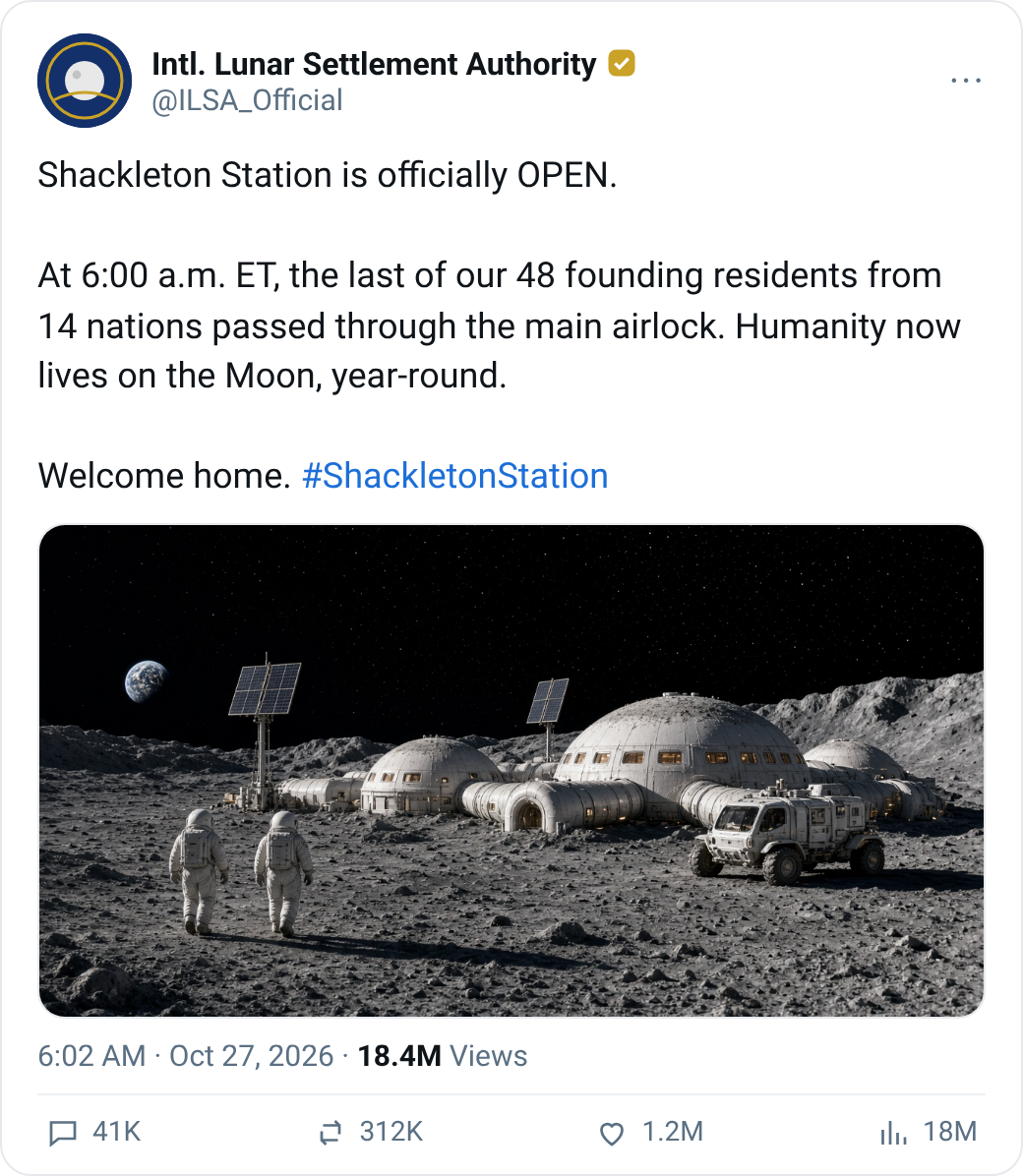
The authority's official account announced the opening at 6:02 a.m. ET.
Eleven domes, 48 residents, a greenhouse growing strawberries and a buried fission reactor. Here is everything we know about the first permanent human settlement on the Moon.
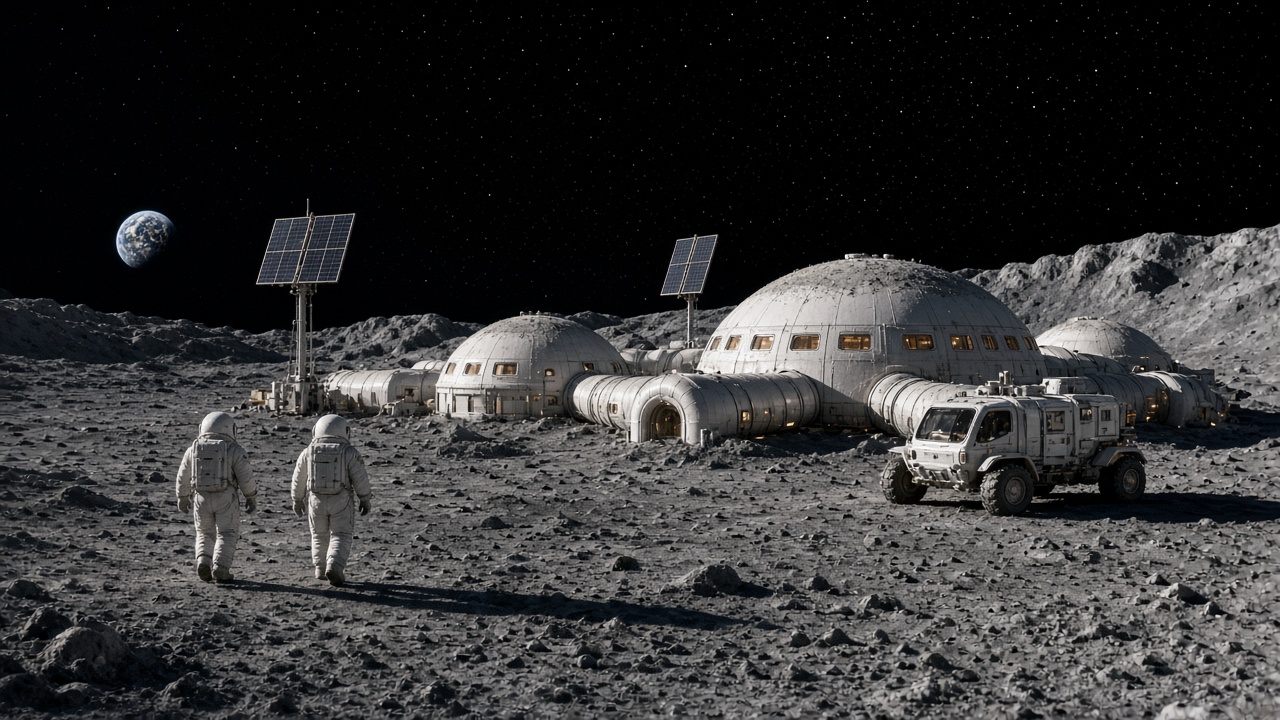
The International Lunar Settlement Authority (ILSA) declared Shackleton Station open early Tuesday, making it the first place beyond Earth where people live permanently rather than on rotating research tours. The milestone came at 6:00 a.m. Eastern time, when the last of the colony's 48 founding residents passed through the main airlock.
"Today we stopped visiting the Moon and started living on it," ILSA Director General Dr. Helena Voss said in a statement released minutes later. The 14-nation authority has managed the project since 2019.
The station sits on the rim of Shackleton Crater, near the Moon's south pole. It is made up of eleven pressurized domes connected by tunnels, with about 4,200 square meters of living and working space. Robotic landers began 3D-printing its radiation shell from lunar regolith in 2023; the domes now sit under nearly two meters of that printed soil.
The authority's official account announced the opening at 6:02 a.m. ET.
Ice is mined from the permanently shadowed floor of the crater and split into drinking water, breathable oxygen and hydrogen fuel. Electricity comes from solar towers on the crater rim, where sunlight is nearly continuous, with a compact fission reactor buried about a kilometer from the habitat as backup.
| Residents today | 48, from 14 countries |
| Domes | 11 (about 4,200 m²) |
| Travel time from Earth | About 3 days |
| Signal delay to Earth | About 1.3 seconds each way |
| Gravity | About one-sixth of Earth's |
| Work schedule | 10-day shifts, then 4 days off |
Commander Rafael Ortega, a former Air Force test pilot, is the station's first chief. Dr. Amara Lindqvist is chief medical officer. Residents rotate through mining, hydroponic farming, maintenance and science work, and the station has a centrifuge gym to fight bone loss, a greenhouse already producing lettuce, tomatoes and strawberries, and an Earth-facing lounge the crew calls "the Front Porch."
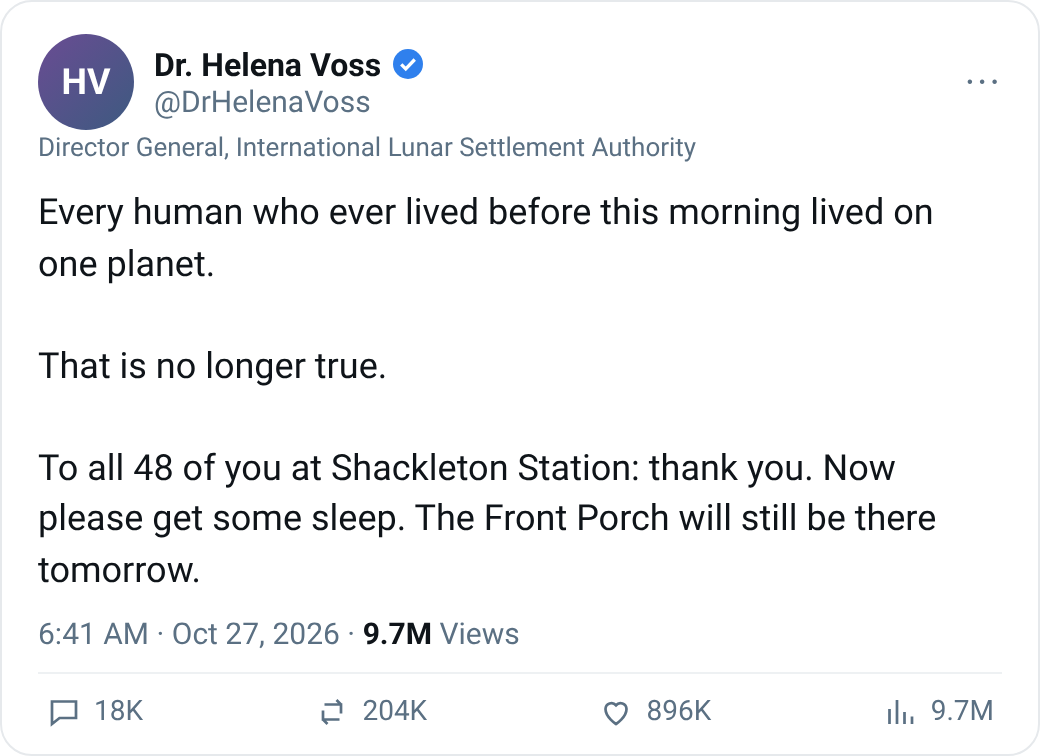
Dr. Helena Voss posted shortly after the airlock closed.
ILSA has not disclosed the project's full cost, and some scientists have asked whether the crater's ice reserves can support a growing population. The authority says a full environmental report will be published next month. Meanwhile, search interest in "how to move to the Moon" jumped more than 4,000 percent in the hour after the announcement, analytics firms said.
Read the authority's official press release, the Orbital Times report, or the encyclopedia entry on the station.