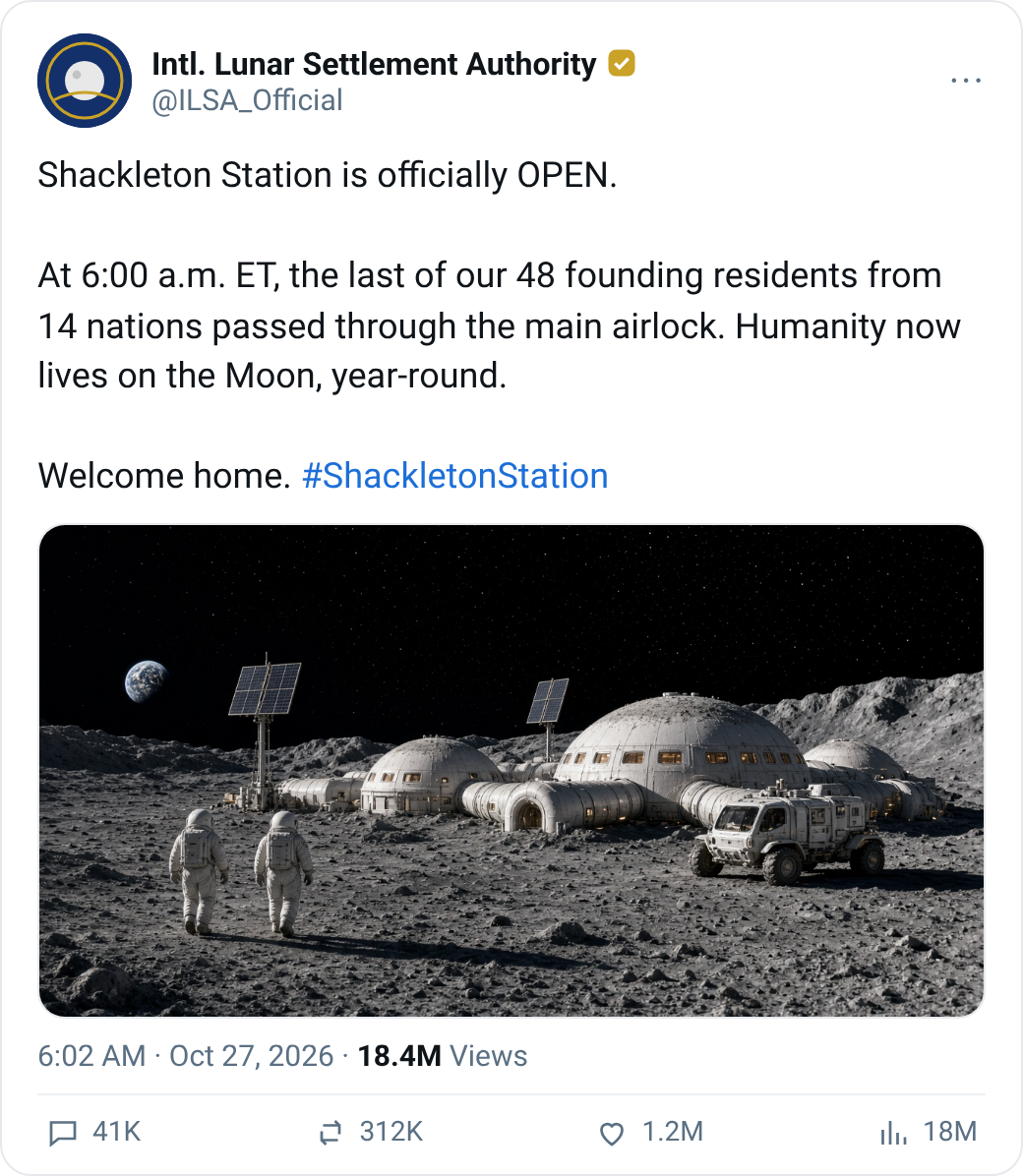
The settlement authority announced the opening on social media at 6:02 a.m. ET.
The settlement near the lunar south pole is the first off-world community designed for people to live in year-round, not just visit. Officials say families could follow by 2029.
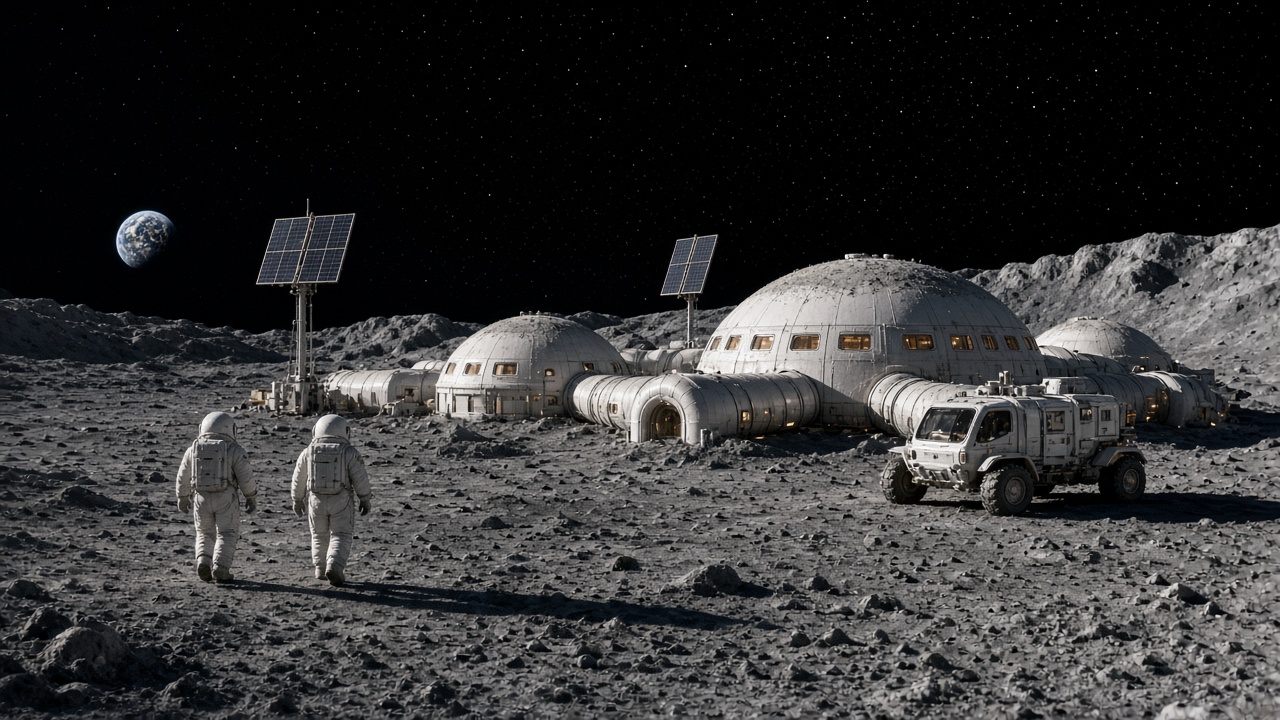
For the first time in history, human beings woke up Tuesday morning on another world with no plans to come home.
Shackleton Station, a cluster of eleven pressurized domes and tunnels built along the rim of Shackleton Crater near the Moon's south pole, was declared officially open at 6:00 a.m. Eastern time, when the last of its 48 founding residents passed through the main airlock. The colony is the first permanent human settlement beyond Earth, built not as a research outpost with rotating crews but as a place where people will live, work and eventually raise children.
"Today we stopped visiting the Moon and started living on it," said Dr. Helena Voss, director general of the International Lunar Settlement Authority, the 14-nation body that has overseen the project since 2019. "Every human who ever lived before this morning lived on one planet. That is no longer true."
The settlement authority announced the opening on social media at 6:02 a.m. ET.
"The kids who are in kindergarten today will grow up in a world where 'Where are you from?' can have the answer 'the Moon.'"Dr. Helena Voss, International Lunar Settlement Authority
Construction began quietly in 2023, when robotic landers began 3D-printing radiation shielding from lunar soil, known as regolith. The station's domes sit under nearly two meters of that printed shell, which engineers say blocks more radiation than a typical commercial flight.
Water comes from ice mined in the permanently shadowed floor of the crater, which is split into drinking water, breathable oxygen and hydrogen fuel. Power comes from solar towers on the crater rim, where the sun shines almost continuously, backed by a compact fission reactor buried a kilometer away.
"People assume the hard part was getting here," said Commander Rafael Ortega, a former Air Force test pilot who will serve as Shackleton's first station chief. "The hard part was making it boring. Hot showers, Wi-Fi, a kitchen that smells like coffee. If it's boring, it's sustainable."
Residents will work 10-day shifts in mining, hydroponic farming, maintenance and science, followed by four days off. The station includes a gym with a spinning centrifuge to fight bone loss, a greenhouse that already grows lettuce, tomatoes and strawberries, and a small observation lounge facing Earth that residents have nicknamed "the Front Porch."
The Moon's gravity is about one-sixth of Earth's, which station doctors say will take some getting used to. "The first week, everyone spills everything," said Dr. Amara Lindqvist, the colony's chief medical officer. "By week three, you see people catching their coffee mid-air without looking. It's honestly beautiful."
Officials said a lottery for civilian residency applications is expected to open in 2027, with the first family housing module scheduled for 2029.
"We have a waiting list in the hundreds of thousands, and we haven't even opened applications."Commander Rafael Ortega, Shackleton Station chief
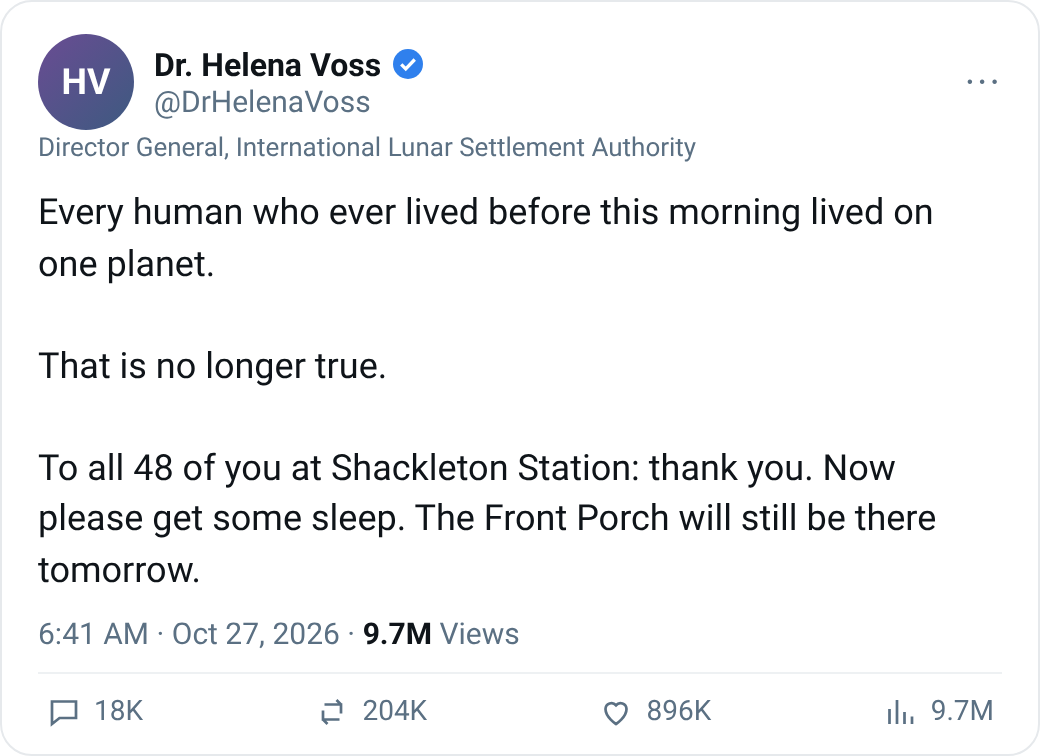
Dr. Voss's post had been viewed nearly 10 million times by mid-morning.
World leaders sent congratulations through the morning, and crowds gathered at watch parties from Houston to Bengaluru to see the live feed of the airlock closing. Search interest in "how to move to the Moon" jumped more than 4,000 percent in the hour after the announcement, according to analytics firms.
Not everyone is celebrating. Some scientists questioned the cost of the project, which has not been fully disclosed, and whether the crater's ice reserves can support a growing population. The settlement authority said a full environmental report will be published next month.
For now, Shackleton's 48 residents have a simpler first goal. "Tonight we're doing a potluck," Ortega said. "Somebody smuggled up hot sauce. I'm not going to ask who."